
Asked about the reports of the troops on both sides disengaging and moving back to their previous positions, Chinese foreign ministry spokesperson Hua Chunying told a media briefing in Beijing that both sides are taking steps to ease the situation along the borders.
China hiked its annual defence budget by 7.1 per cent.
....a long-term boundary agreement is reached between the two countries.

China said it was committed to peace and tranquility at the border areas.
'We must be careful because China has not given its design in Eastern Ladakh.'

On the first anniversary of the deadly clashes, the army said the supreme sacrifice of the soldiers while fighting the adversary in the "most difficult" high altitude terrain will be "eternally etched" in the memory of the nation.
The focus of the deliberations was on finalising modalities for disengagement of troops in eastern Ladakh.

Besides the border question, India and China discussed issues related to counterterrorism including Beijing's blocking of India's bid in the United Nations to ban Pakistan-based JeM chief Masood Azhar, National Security Advisor Ajit Doval said on Thursday.

While OnePlus 8 and 8 Pro were launched in April, the devices were not brought into the Indian market given the lockdown.
The sources said the mutual disengagement of troops at the two friction points is likely to be completed within two days, and that there has been 'substantial' withdrawal of forces by Chinese military from the areas.
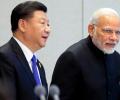
It is apparent that an easing of tensions at the border and a disengagement of troops is on the cards, observes Ambassador M K Bhadrakumar.
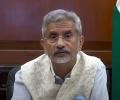
The external affairs minister said the broad principle around which his position would be constructed would be about the importance of maintaining peace and tranquility along the border for the overall development of ties which has been reflected in the last 30 years of the relationship.
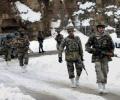
'To deal with a bully, you have to deal from a position of strength, not a position of weakness.'
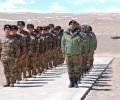
There was no comment from the Indian side on the statement made by the Chinese defence ministry spokesperson Colonel Wu Qian, and carried by China's official media.

Congress's chief spokesperson Randeep Surjewala also said all Indians should ask the government this Independence Day what it was doing to protect the country and push China back.
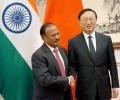
The decision was taken during the annual 19th round of boundary talks in Beijing between National Security Advisor Ajit Doval and his Chinese counterpart Yang Jiechi.
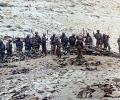
At least 38 PLA troops drowned while crossing a fast-flowing, sub-zero river in darkness, according to an article in the Australian newspaper The Klaxon which cited a report prepared by a group of social media researchers after a year-long investigation.

'We are facing the most critical military situation with China in the last 50 years.'
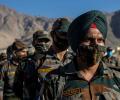
Calling the 'events' along the Line of Actual Control (LAC) very disturbing, the external affairs minister said they have raised some very 'basic concerns'. When asked whether it will be a long-haul or a breakthrough is expected soon, Jaishankar said: "I would not go into prediction zone at all whether it is going to be easy or not, and what will be the timelines and so on."
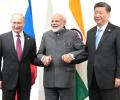
For the first time since the standoff between Indian and Chinese troops along the Line of Actual Control (LAC) in eastern Ladakh, Prime Minister Narendra Modi and Chinese President Xi Jinping are expected to come face-to-face virtually at the BRICS (Brazil-Russia-India-China-South Africa) annual summit to be held on November 17.
The 60-metre bridge is around four kilometres east of the confluence of Shyok and Galwan rivers, and links the narrow mountainous region to the Shyok-Daulat Beg Oldi road.

While Prakriti's father has retired from the Indian Air Force, Deeksha's father Kamlesh Kumar is an Inspector in the ITBP.
Within the army, there is growing concern that New Delhi will allow the Chinese to retain the territory they have occupied in the last month.
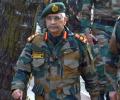
The commanders will also deliberate on the overall situation in Jammu and Kashmir besides delving into issues having national security implications, they said. However, the main focus will be on the situation in eastern Ladakh where Indian and Chinese troops are locked in an eyeball-to-eyeball face-off in Pangong Tso, Galwan Valley, Demchok and Daulat Beg Oldie, the sources said.

The government has also relaxed certain rules to cut delays in military purchase like allowing the three services to procure required weapons and equipment from a single vendor, the sources said.
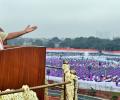
He made a reference to the clash between Indian and Chinese troops in Ladakh's Galwan Valley in June this year. "What our jawans can do, what the country can do, the world has seen in Ladakh," he said.

'Galwan has turned everything.' 'The casualties on both sides alerted the Chinese to the fact that Indians are not going to take it lying down.'
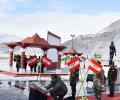
The Chinese authorities have been rapidly building defence infrastructure along the Line of Actual Control, indicating that they are preparing for a long period of tension with India, points out Jayadeva Ranade, the former senior RA&W officer and China expert.
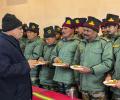
Singh visited Tawang on Thursday for the 'Maitree Diwas' celebrations to boost civil-military friendship in the region bordering China.

The government has adopted a multi-pronged approach involving the Army, the Indian Air Force and the Navy as well as diplomacy and economic measures to send out a firm and clear message to China that its misadventure in eastern Ladakh was not acceptable at all.

His attack on the government came a day after Defence Minister Rajnath Singh assured Parliament that India has not conceded anything in the sustained talks with China and it will not allow even an inch of its territory to be taken away by anyone.

Defence Minister Rajnath Singh held two-back-to-back meetings with top military brass on Tuesday deliberating on the situation in eastern Ladakh after an Indian Army officer and two soldiers were killed in a violent clash with Chinese troops in Galwan Valley.
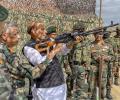
Rajnath Singh believes it would be naive to see disengagement of the armies from the LAC as the end of the trouble. The defence minister has urged the defence forces to be ready for a long haul
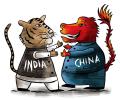
India and China achieved a major milestone this year when their bilateral trade crossed the landmark figure of $100 billion but it did not generate any fanfare in both capitals as the two Asian giants are going through a "particularly bad patch" in their relations due to a set of actions by Beijing in violation of agreements that led to the military standoff in eastern Ladakh. Starting with a modest $1.83 billion in 2001, the bilateral trade crossed $100 billion-mark in the first 11 months this year, a significant milestone for which the two countries carried out campaigns to boost trade and build it as a major stakeholder to improve the relations between two nations, whose ties otherwise remained frosty over the festering boundary dispute and strategic rivalry. According to last month's data from China's General Administration of Customs (GAC), the India-China bilateral trade totalled $114.263 billion, up 46.4 per cent year-on-year from January to November 2021.
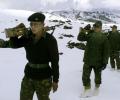
Special Representatives of China and India have held 19 rounds of talks to resolve the boundary issue.

The use of the strategic road by the Indian security forces from Leh has helped in reducing the travel time between Leh and DBO to six hours.
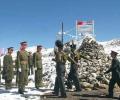
People familiar with the situation in the region said the two sides were engaged in trying to resolve the dispute, but there was no indication of a positive outcome yet as both the armies continued to bolster their positions in disputed areas of Pangong Tso and Galwan Valley and Demchok.

The visit comes a week after 20 Indian Army personnel were killed in a brutal assault by the Chinese military in Galwan Valley which escalated the border tension.

He also said it was important that even during the difficult moments of this "crisis" India has been communicating and engaging with China.

He said there were no signs of an "overt collusion" between China and Pakistan during the Ladakh standoff but India also caters to a long term strategy for not a two, but a two-and-half front war. With the half front, he was referring to the internal security.
